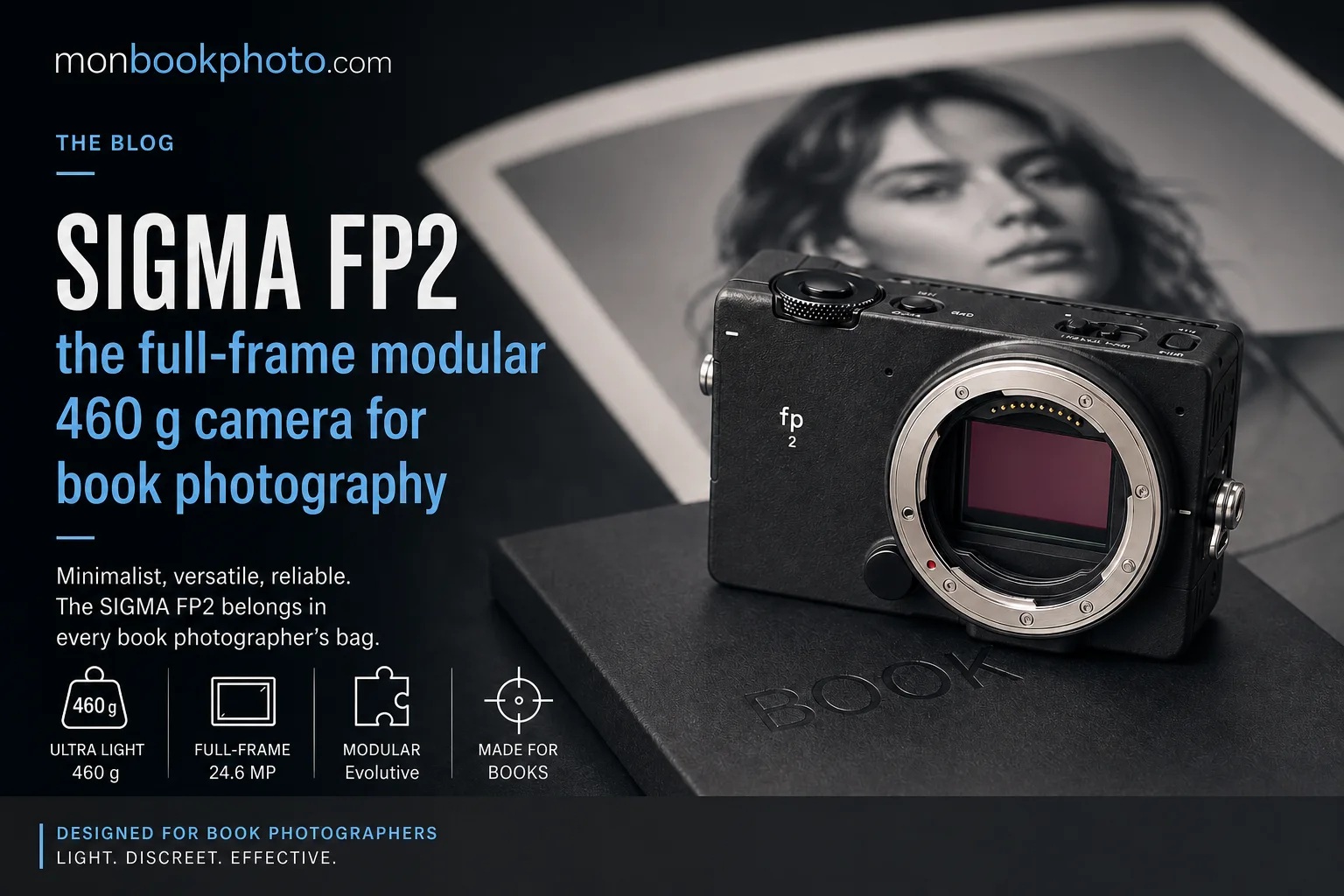
On October 23, 2026, Sigma unveiled the FP2, the second generation of its modular L-mount full-frame mirrorless camera. Seven years after the original fp, the brand keeps the idea of a minimalist body you build up as needed, but it overhauls the sensor, autofocus, screen and battery life. That leaves the question that matters to our readers: is this 460 g body a good tool for portraits, artistic nudes and model portfolios?
Key features of the Sigma FP2
A faster sensor, same resolution
The FP2 is built around a partially stacked full-frame CMOS sensor with 24.5 effective megapixels. According to DPReview, it is a back-illuminated sensor with fast readout circuitry placed around its edges, which speeds up readout without the cost of a fully stacked sensor. For stills, this means:
- bursts of up to 20 fps, sustained for 180 DNG or 200 JPEG files, and 630 DNG files at 8 fps;
- less rolling-shutter distortion than the fp;
- 14-bit lossless DNG RAW files of 6,016 x 4,012 pixels;
- an ISO range of 100 to 102,400, with dual base ISOs of 320 and 2,500 for stills.
Autofocus that finally measures up
This was the fp’s weak spot. The FP2 combines on-sensor phase detection with contrast detection, adding subject tracking (people, dogs and cats, birds) and eye detection. Rated sensitivity goes down to -5 EV. For wide-aperture portraits, eye detection is the most tangible improvement in this generation.
Handling and modularity
- 3.15-inch tilting touchscreen with about 2.1 million dots, tilting from roughly +90° to -45°.
- Optional EVF-21 electronic viewfinder with 5.76 million dots and an eye sensor.
- Optional HU-21 hot-shoe unit, compatible with the OM System and Panasonic system according to DPReview.
- 70 GB of internal memory, an SDXC UHS-II slot and recording to an external USB SSD.
- 16 Wh battery rated for about 370 shots per charge.
- 460 g including battery and card.
On the video side, the FP2 records 6K open gate, including ProRes RAW to an SSD. That is not our focus here, but it confirms the body targets filmmakers as much as photographers.
Price and availability
- Availability: November 11, 2026.
- United States: US$2,199 body only, US$2,749 with the EVF-21 viewfinder or with the 50mm F2 DG Contemporary.
- France: €2,199 body only according to Frandroid, and €2,199.90 for pre-order at MN Photo Vidéo.
- Canada: no Canadian dollar price had been published at the time of writing.
How it compares with the fp, the fp L and the competition
Versus the fp and fp L
The fp (24.6 MP) and fp L (61 MP) weigh 422 g and 427 g respectively with battery and card. The FP2 is therefore slightly heavier, the trade-off for a tilting screen and a bigger battery. All three bodies share one thing: no mechanical shutter.
- Versus the fp: same resolution, but much more modern autofocus, faster bursts, a tilting screen and flash sync that improves from 1/30 s to 1/50 s.
- Versus the fp L: the fp L keeps its resolution advantage (61 MP) for cropping and large prints, but its flash sync tops out at 1/15 s, which makes it poorly suited to mixing flash with ambient light.
For portfolio work, the FP2 thus becomes the most versatile body in the family.
Versus competing 24 MP full-frame mirrorless cameras
DPReview believes the FP2’s sensor is probably comparable to those in the Nikon Z6III and Panasonic S1II, two cameras in the same class. These rivals are bulkier, but they offer what the Sigma lacks: a built-in viewfinder, a mechanical shutter and in-body image stabilization. The FP2 only offers electronic stabilization, and only for video. The same holds against compact full-frame models such as the Sony A7C II and Nikon Z5II, or the Leica SL3-S, which shares the L-mount: all of them have a mechanical shutter and sensor-shift stabilization. The choice comes down to extreme compactness versus classic versatility.
Why it matters for portrait, artistic nude and portfolio photography
Strengths
- Discretion: a silent 460 g body is less intimidating for a first-time model and suits artistic nude sessions where calm matters.
- Eye detection: it locks focus reliably at f/1.4 or f/1.2, especially in natural light.
- The L-mount: it gives access to Sigma, Panasonic and Leica lenses, including fast portrait primes such as the Sigma 85mm F1.2 DG Art.
- Color modes: thirteen profiles, including soft looks that help keep a consistent visual signature across a portfolio.
- 70 GB of internal memory: a welcome safety net during a long session.
Limitations to know about
Electronic shutter only
This is the main limitation. With no mechanical shutter, the FP2 remains prone to banding under some flickering artificial light (cheap LEDs, fluorescent tubes) and to distortion with fast-moving subjects, even if the faster sensor reduces it. In the studio, favor good-quality continuous lights and check your images from the very first frames.
Flash
Maximum flash sync speed is 1/50 s. That is a real improvement, but still far from the usual 1/200 s or 1/250 s of bodies with a mechanical shutter. In practice:
- outdoors, it is hard to darken a sky or a bright background with flash without an ND filter;
- in the studio, modeling light can mix with the flash, so switch off modeling lamps or work in a dark room;
- the hot shoe is not built in: you need the HU-21 unit to mount a flash or trigger.
Handling and battery life
With no built-in viewfinder, composing on the screen is less comfortable in bright sun, and the EVF-21 adds bulk and cost. About 370 shots per charge means at least one spare battery for a full session. Finally, the lack of in-body stabilization calls for discipline with shutter speeds on longer lenses.
Who is the Sigma FP2 for?
- Portrait photographers who mainly work in natural light and want a discreet full-frame camera.
- Hybrid photo and video shooters who want a single, very compact body.
- L-mount lens owners looking for a light second body.
It is less suited to studio photographers who mostly work with flash, for whom a body with a mechanical shutter remains simpler.
Conclusion
The Sigma FP2 fixes the fp’s major weaknesses: autofocus, burst speed, screen and battery life. For natural-light portfolio work, it is an appealing and discreet tool. For flash work, the electronic shutter and 1/50 s sync remain constraints. Before buying, test it under your own lighting as soon as it ships on November 11, and budget for the HU-21 unit and a spare battery.